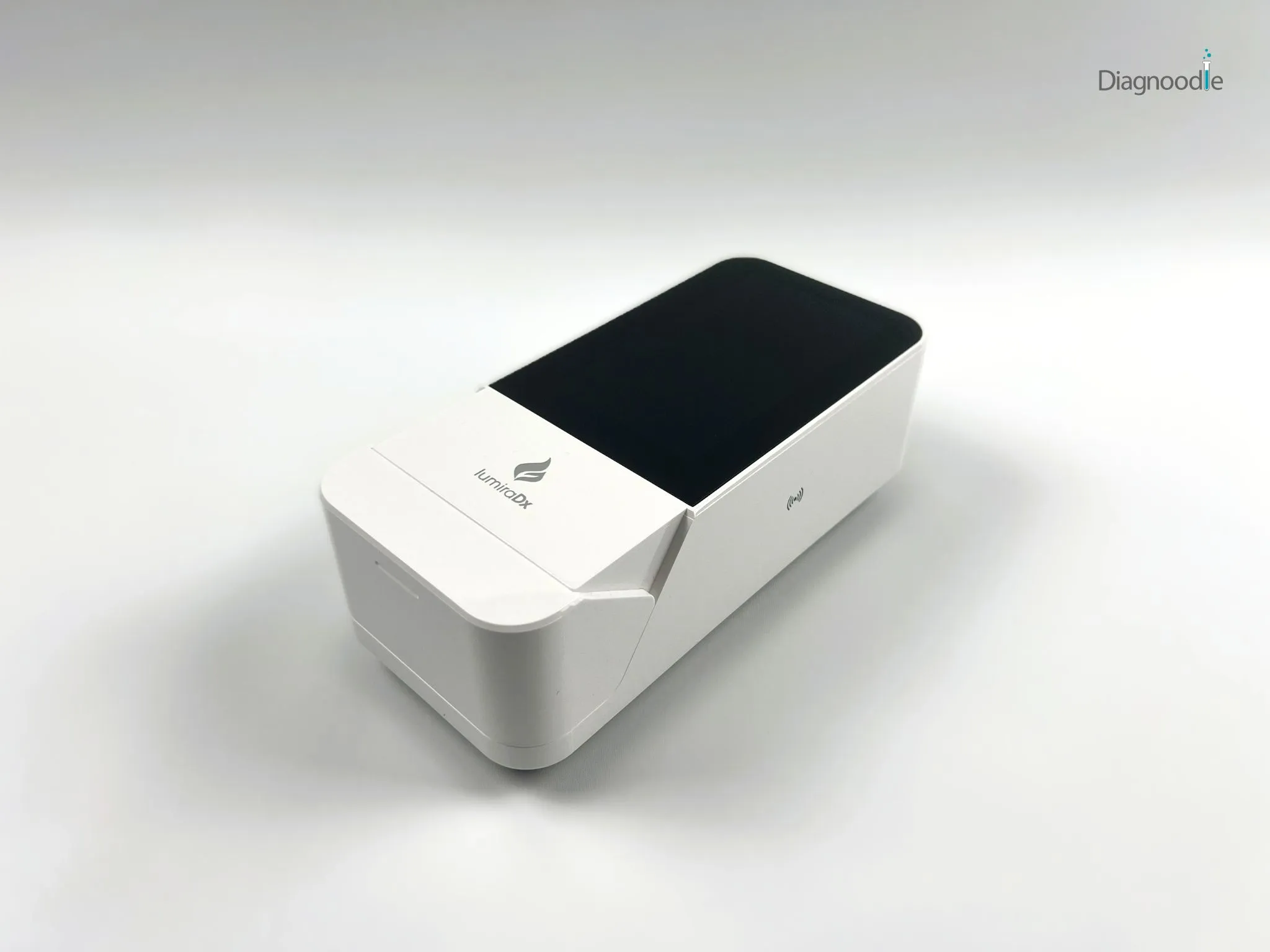

QuikRead go Plus
Das QuikRead go Plus von Aidian ist ein vollautomatisiertes Point-of-Care-Analyseinstrument für die schnelle, präzise und quantitative Diagnostik direkt am Patienten. Es liefert CRP-, HbA1c-, iFOBT-, Strep-A- und weitere Ergebnisse in wenigen Minuten und unterstützt damit schnelle klinische Entscheidungen. Wartungsfreiheit, kalibrationsfreie Testkits, robuste Qualitätskontrolle und eine sichere LIS/KIS-Konnektivität machen das Gerät ideal für Praxen, Ambulanzen und Einrichtungen, die zuverlässige Sofortdiagnostik benötigen.
Das System arbeitet photometrisch und turbidimetrisch und nutzt cuvettenkodierte Kalibrierdaten für zuverlässige Ergebnisse ohne manuelle Eingriffe. Es verfügt über ein kapazitives Touch-Interface, automatisierte Self-Checks und integriertes QC-Management. Der interne Speicher fasst bis zu 6.000 Patienten- und 6.000 QC-Ergebnisse. Über LAN oder WLAN lässt sich das QuikRead go Plus nach LIS01-A2 oder POCT1-A2 in Labor- und Krankenhausinformationssysteme einbinden. Der Betrieb ist über Netzteil oder Akku möglich, was eine flexible Nutzung in mobilen und stationären Umgebungen erlaubt.
- Allgemeinmedizinische Praxen und hausärztliche Versorgung
- Ambulante Einrichtungen, MVZs und schnelle Diagnostikbereiche
- POC-Stationen in Kliniken mit Bedarf an sofortigen Laborparametern
- Mobile Einsatzbereiche wie Hausbesuche und Notfallteams
- Stationäre Bereiche, in denen CRP, HbA1c, iFOBT oder Strep A in Echtzeit benötigt werden
- CRP-Sofortbestimmung zur Differenzierung bakterieller und viraler Infektionen
- HbA1c-Messung zur unmittelbaren Diabeteskontrolle während des Patientenbesuchs
- Strep-A-Diagnostik zur schnellen Abklärung akuter Halsschmerzen
- iFOBT-Screening zur Erkennung von okkulten gastrointestinalen Blutungen
- CRP+Hb-Kombination zur gleichzeitigen Beurteilung von Entzündungen und Anämie
- Ergebnisse in 2 bis 6 Minuten für schnellere Behandlungsentscheidungen
- Wartungsfrei und ohne Kalibrieraufwand dank cuvettenbasierter Datencodierung
- Sehr geringer Hands-on-Aufwand durch gebrauchsfertige Reagenzien
- Vergleichbare Laborqualität durch präzise photometrische und turbidimetrische Messung
- Vollständige Rückverfolgbarkeit mit Operator-/Patienten-ID und QC-Management
- Sichere, automatisierte LIS/KIS-Übertragung per LAN oder WLAN
- Mobile Nutzung durch leichten Formfaktor, Tragegriff und langlebigen Akku
- Minimierung von Dokumentationsfehlern durch automatisierte Datenübermittlung
Das QuikRead go Plus unterscheidet sich durch seine Kombination aus schneller Messzeit, wartungsfreiem Betrieb, integrierter Qualitätskontrolle und breitem Parameterspektrum. Viele POC-Geräte bieten entweder nur qualitative Ergebnisse oder benötigen regelmäßige Kalibrierungen – das QuikRead go Plus dagegen arbeitet vollständig automatisiert, ohne Kalibrieraufwand, und liefert quantitative Resultate mit Laborvergleichbarkeit. Auch die flexible LIS/KIS-Anbindung über zwei etablierte Standards ist ein Vorteil in komplexen klinischen Strukturen. Da die Unterlagen keine direkten Konkurrenzsysteme nennen, basieren diese Vergleichspunkte auf den dokumentierten Funktionsunterschieden.
Parameter overview
It is possible that certain calculated parameters are not specified.
Tests (7)
CRP
easy CRP
wrCRP+Hb
Probentyp: Vollblut, Plasma, Serum (CRP) & Vollblut (Hb).
HbA1c
Strep A
Zeit bis zum Ergebnis: 2 bis 4 Minuten.
iFOBT
CRP+Hb
CRP
easy CRP
wrCRP+Hb
Probentyp: Vollblut, Plasma, Serum (CRP) & Vollblut (Hb).
Studies & Product Documents
AI Summary
Die vorliegenden Anwendungsstudien zeigen, dass der quantitative immunologische Stuhltest (FIT), wie er mit dem QuikRead go System durchgeführt wird, ein effektives und übertragbares Werkzeug für die klinische Diagnostik bei Patienten mit Symptomen eines kolorektalen Karzinoms darstellt. Im Fokus der Untersuchungen stand die diagnostische Genauigkeit, wobei die Sensitivität für die Erkennung von Darmkrebs bei Nutzung der Nachweisgrenze maximiert wird. Studien belegen, dass die Leistung des FIT bei verschiedenen Analysegeräten und sowohl bei Hochrisiko- als auch bei Niedrigrisiko-Symptomen vergleichbar bleibt, sofern ein einheitlicher Schwellenwert verwendet wird. Während ein Schwellenwert von 10 Mikrogramm Hämoglobin pro Gramm Stuhl eine hohe Sensitivität bietet und dabei hilft, Hochrisikopatienten zu priorisieren sowie unnötige Koloskopien zu reduzieren, unterstreichen die Daten auch die Notwendigkeit adäquater Sicherheitsvorkehrungen bei testnegativen Patienten mit anhaltenden Symptomen. Insgesamt wird der FIT als zuverlässiges, nicht-invasives Triage-Instrument bewertet, das sich nahtlos in die Primärversorgung integrieren lässt, um die diagnostischen Pfade effizienter zu gestalten.
"Test sensitivity at a threshold of 10 μg/g highlights a requirement for adequate safeguards in test-negative patients with ongoing symptoms. Further research is needed into the impact of patient characteristics and dual FIT."
"FIT sensitivity for CRC detection is maximised at the LoD; its performance is similar in high and low-risk symptoms, and across different analysers where a common threshold is used. FIT performance for CRC detection is adequate and transferrable to clinical diagnostic pathways."
This Swedish study protocol evaluates the diagnostic accuracy and cost-effectiveness of quantitative faecal immunochemical tests (FIT) for symptomatic patients in primary care. By analyzing two samples from 3,000 participants aged 40 and above, researchers aim to confirm a hypothesized 95% sensitivity at a 10 micrograms Hb/g cutoff to safely rule out colorectal cancer. The findings will help establish FIT as a reliable non-invasive triage tool to prioritize high-risk referrals and reduce unnecessary colonoscopies in real-world clinical settings.
AI Summary
Die vorliegenden Vergleichsstudien zeigen ein differenziertes Bild zur Performance des QuikRead go in verschiedenen klinischen Einsatzbereichen. Bei der Bestimmung des C-reaktiven Proteins (CRP) wird das Gerät als zuverlässiges quantitatives System eingestuft, das im Vergleich zu semiquantitativen Tests sowie Geräten wie dem Spinit eine hohe Genauigkeit aufweist (Calarco et al., 2023). Während die Sensitivität in einer Meta-Analyse (Sahoo et al., 2026) niedriger als bei FebriDx® oder NycoCard Reader II bewertet wurde, bescheinigen andere Studien dem QuikRead go sowie dem QuikRead 101 eine insgesamt adäquate analytische Leistung und Übereinstimmung, vergleichbar mit Systemen wie Afinion oder Eurolyser (Minnaard et al., 2013; Van Hoovels et al., 2024). Im Bereich der HbA1c-Messung zeigt das Gerät eine hohe Robustheit gegenüber der Hämoglobinvariante Hb Tacoma, während andere Immunoassays wie der Standard F signifikante Fehlmessungen aufweisen (Mäenpää et al., 2024). Dennoch erfüllte das System in einer Untersuchung (Lenters-Westra et al., 2020) im Gegensatz zu Cobas b101 die strengen internationalen Qualitätskriterien für HbA1c nicht. Beim Nachweis von Gruppe-A-Streptokokken bietet der QuikRead go Strep A eine zum BD Veritor™ äquivalente diagnostische Sicherheit.
POCT-CRP testing is a valuable tool for distinguishing between bacterial and viral ARTIs, supporting more accurate antibiotic prescribing. While our meta-analysis shows high overall specificity (86%), sensitivity varies significantly by device; the FebriDx® (84%) outperformed both the NycoCard Reader II (54%) and QuikRead (35%). Although these tools enhance clinical decision-making, further evidence regarding their cost-effectiveness is essential to ensure they provide genuine healthcare value rather than simply increasing diagnostic expenses.
While most tested HbA1c methods [Afinion 2, HbA1c 501 (both utilizing boronate affinity), QuikRead go, cobas b 101, DCA Atellica] show minimal bias, the Standard F immunoassay exhibits a clinically significant interference with Hb Tacoma, resulting in a 38% mean relative bias (17 mmol/mol). This discrepancy likely stems from conformational changes in the variant affecting the assay's two-antibody design. Given the regional prevalence of Hb Tacoma, these findings highlight the necessity of selecting variant-robust methods to ensure accurate glycemic monitoring and patient safety.
"The analytical performance and user-friendliness of POCT-CRP devices [QuikRead go easy, LumiraDx, cobas b 101 and Afinion 2] varies among manufacturers, emphasizing the need for quality assurance supervised by a central laboratory."
This study compared 17 point-of-care CRP tests and found that quantitative tests are significantly more reliable than semi-quantitative ones. While models like QuikRead go and Spinit showed high accuracy, many others exhibited substantial bias or poor performance in intermediate clinical ranges (10–80 mg/L). Ultimately, the researchers recommend quantitative POC devices as the superior choice for managing infections and supporting antibiotic stewardship, as they provide the consistent precision needed across all diagnostic categories.
"This unique and comprehensive study shows that out of six POC analyzers studied only two (The Lab 001 and Cobas B101) met international quality criteria (IFCC and NGSP), two (A1Care and Innovastar) were borderline and two (QuikReadgo and Allegro) were unacceptable. It is essential that the scientific and clinical community are equipped with this knowledge in order to make sound decisions on the use of these analyzers."
"Analytical performance, agreement, and user-friendliness of the POC CRP tests [Afinion and NycoCard Reader II (both Alere), Eurolyser Smart 700/340 (Eurolyser), QuikRead go and QuikRead 101 (both Orion Diagnostica)] varied considerably, yet overall four devices showed adequate analytical performance and agreement."
Both the BD Veritor™ system and the QuikRead go® Strep A test demonstrated comparable diagnostic performance, with the BD Veritor™ showing slightly higher agreement and specificity. Given their identical sensitivity of 80%, the selection of a point-of-care test for the emergency room should be based on practical factors such as cost, instrument size, and ease of implementation rather than clinical accuracy alone.
AI Summary
Die vorliegenden Laborevaluierungen zeigen, dass das QuikRead go® System eine klinisch verlässliche Performance bietet, die im Vergleich zu etablierten Laborsystemen wie dem FOB Gold Wide® oder dem OC-Sensor iO® als akkurat und anforderungsgerecht eingestuft wird. In den Studien erwies sich das Gerät als wertvolles Instrument für die Point-of-Care-Diagnostik (POCT), insbesondere bei der Triagierung von Patienten mit Verdacht auf kolorektale Karzinome (CRC). Hierbei zeigte das System eine hohe Sensitivität und starke Fähigkeiten zur Risikostratifizierung, selbst bei symptomatischen Patienten. Während die Übereinstimmung an den negativen Schwellenwerten gut ist, tendiert das QuikRead go® dazu, eine höhere Anzahl an Patienten für weitere Untersuchungen zu identifizieren, was die diagnostische Sicherheit erhöht. Neben der fäkalen Analytik wurde auch die Bestimmung von Entzündungsparametern wie dem C-reaktiven Protein (CRP) und weißen Blutkörperchen positiv bewertet, wobei das System die klinische Entscheidungsfindung und das Antibiotic Stewardship effektiv unterstützt. Insgesamt bestätigen die Daten, dass das Gerät die Herstellerspezifikationen erfüllt und eine praxistaugliche Alternative zur Zentrallaboranalytik darstellt.
"Larger studies to evaluate the accuracy and consequences of using FIT for surveillance of colorectal neoplasia are needed. FIT may be more interesting for post-resection CRC surveillance than follow-up of adenoma."
"Our results showed that the POCTs can be used by some patients and factors influencing the patient participation included psychological and physical limitations. Both POCTs appeared to have an acceptable clinical level of accuracy."
"Each system performed according to their manufacturers’ claims. The QuikRead go and OC-Sensor iO are suitable for use. The Eurolyser Cube is not recommended because of the risk of falsely low results."
"This POC FIT device is a useful adjunct to better manage TWW patients. The high observed sensitivity for CRC offers opportunities, within a single consultation, for improved triage and rationalization of investigation for those with bowel symptoms."
"One or two FITs in symptomatic patients referred for colonoscopy imply powerful risk stratification abilities for CRC, even among patients reporting rectal bleeding. Larger studies in various settings will clarify how to make the best use of this opportunity."
"An over-prescription of antibiotics for febrile patients was observed, even for those with low CRP levels and without a confirmed bacterial infection. The added value of the FebriDx was limited, while the combined use of rapid tests for qCRP and malaria should be considered for the management of acute febrile illness and antibiotic stewardship."
"Both systems were accurate in their ability to detect CRC. Whilst good agreement around the negative threshold was identified, more patients would be triaged to further colonic investigation if using the QuikRead go®."
"For all faecal immunochemical test brands, there are strategies at which the incremental net monetary benefit is positive compared with current care. The exact brand and threshold(s) that generate the greatest incremental net monetary benefit could not be robustly determined due to the similarity of incremental net monetary benefit values, parameter uncertainty and the possibility of omissions from the model structure."