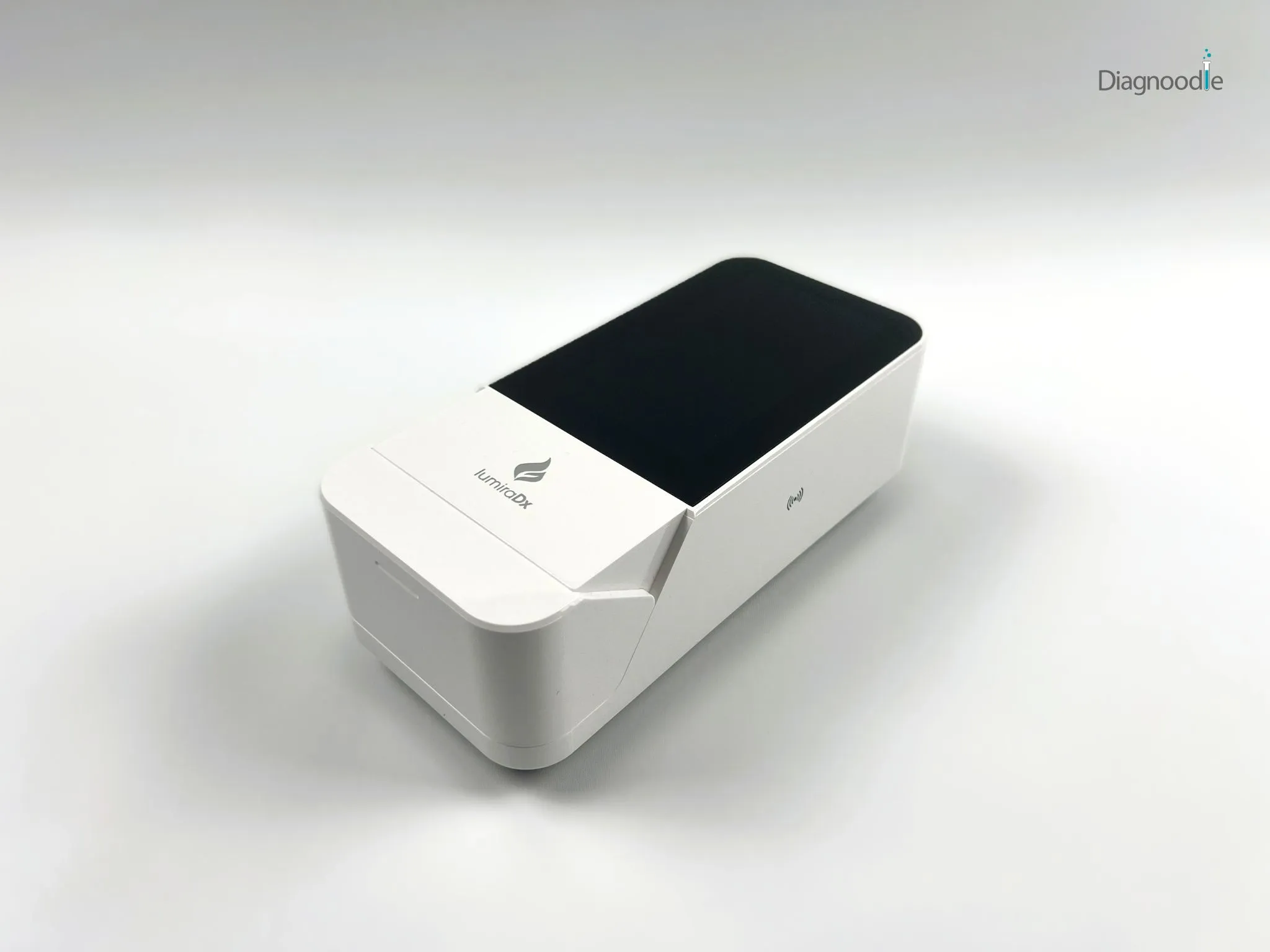

AQT90 Flex
Der AQT90 Flex von Radiometer ist ein vollautomatischer Point-of-Care-Immunoassay-Analysator für kardiale, infektiologische, gerinnungsrelevante und endokrinologische Biomarker. Das System liefert laborkorrelierte Ergebnisse direkt am Behandlungsort und ermöglicht schnelle Diagnostik innerhalb von 11 bis 21 Minuten. Mit geschlossenem Probenhandling, automatisierter Qualitätskontrolle und vollständiger LIS/HIS-Konnektivität ist der Analysator auf hohe Auslastung, schnelle Turn-around-Zeiten und sichere Prozesse in der Akutversorgung ausgelegt.
Der AQT90 Flex nutzt zeitaufgelöste Fluoreszenz mit Europium-Tracer zur hochsensitiven Bestimmung von Biomarkern. Das Gerät misst bis zu fünf Parameter aus einer Probe und verarbeitet Vollblut oder Plasma ohne Probenvorbereitung. Es bietet eine vollständig geschlossene Workflow-Architektur mit automatischem Pipettieren, integrierter Probenerkennung und mehrstufiger Qualitätskontrolle. Die IT-Anbindung erfolgt über HL7, ASTM und POCT1-A. Das System unterstützt bis zu 30 Tests pro Stunde, 240 Tests im Cartridge-Inlet sowie 23 bis 25 Tage Onboard-Stabilität der Reagenzien.
- Notaufnahme zur schnellen Beurteilung kardialer, gerinnungsrelevanter oder infektiöser Zustände
- Intensivstation für engmaschiges Monitoring kritischer Biomarker
- Akut- und Schockräume für schnelle Differentialdiagnostik
- Präoperative oder perioperative Versorgung
- Ambulante oder dezentrale medizinische Einrichtungen
- Ausschluss oder Bestätigung eines akuten Myokardinfarkts (Troponin I, CK-MB, Myoglobin)
- Akute Dyspnoeabklärung, insbesondere zur Beurteilung einer möglichen Herzinsuffizienz (NT-proBNP)
- Infektions- und Sepsisdiagnostik im Rahmen des Notfallmanagements (CRP, PCT)
- Ausschluss venöser Thromboembolien bei hoher klinischer Relevanz (D-Dimer)
- Schwangerschaftsdiagnostik mittels β-hCG bei akuten Fragestellungen
- Ergebnisse innerhalb von 11 bis 21 Minuten zur schnelleren Entscheidungsfindung
- Bis zu 30 Tests pro Stunde sowie parallele Messung mehrerer Parameter
- Geschlossenes Probenhandling ohne Blutkontakt für mehr Anwendersicherheit
- Keine Probenvorbereitung, kein Pipettieren, direktes Einsetzen von Standardröhrchen
- Integrierte Qualitätskontrolle auf mehreren Ebenen
- Hohe analytische Sensitivität dank zeitaufgelöster Fluoreszenz
- Vollständige LIS/HIS-Anbindung für durchgängige Dokumentation und Prozessintegration
- Multitest-Cartridges mit bis zu 16 Tests pro Cartridge und bis zu 240 Tests im Gerät
Der AQT90 Flex positioniert sich im Umfeld hoher Fallzahlen in Klinik und Akutmedizin. Das geschlossene Probenhandling minimiert manuelle Schritte und reduziert Fehlerquellen, während die Messung mehrerer Parameter aus einer einzigen Probe zur schnelleren Entscheidungsfindung beiträgt. Die Testkapazität von bis zu 30 Analysen pro Stunde sowie die lange Stabilität der Reagenzen im Gerät entlasten den Prozess im Betrieb. Einige kompaktere Systeme bieten ein kleineres Portfolio an kardialen und infektiologischen Markern und verlangen häufig eine visuell zu überwachende Probenvorbereitung. Andere setzen zwar ebenfalls auf moderne Assaytechnologien, erreichen jedoch nicht die gleiche Integration in Labor und Klinik IT via HL7, ASTM und POCT1 A.
Parameterübersicht
Es ist möglich, dass bestimmte berechnete Parameter nicht angegeben sind.
Testübersicht (8)
beta-hCG
CRP
PCT
NT-proBNP
Troponin I
D-Dimere
Myoglobin
CK-MB
beta-hCG
CRP
PCT
Studien & Produktdokumente
KI-Zusammenfassung
Die vorliegenden Anwendungsstudien zeigen, dass der AQT90 FLEX eine vielseitige und klinisch wertvolle Lösung für die patientennahe Sofortdiagnostik (POCT) darstellt. Im gynäkologischen Notfallmanagement ermöglicht das Gerät durch die schnelle quantitative Bestimmung von Beta-hCG eine signifikante Verkürzung der Wartezeiten und der Verweildauer der Patientinnen, wobei die Anbindung an Middleware die lückenlose Rückverfolgbarkeit und Qualitätskontrolle durch das Zentrallabor garantiert. Für die kardiologische Diagnostik in der Notaufnahme wurde belegt, dass der cTnI-Assay die strengen klinischen Anforderungen erfüllt und eine mit Zentrallaboren vergleichbare analytische Leistung erbringt. Während der alleinige cTnT-Test am POCT-Gerät zur Bestimmung der 99. Perzentile kritischer bewertet wurde, zeigt die Forschung, dass die Kombination von cTnT mit Copeptin die diagnostische Genauigkeit beim frühen Ausschluss eines Myokardinfarkts erheblich verbessert und eine Leistung auf dem Niveau hochsensitiver Troponin-Tests erreichen kann. Ein ISO 22870-konformer, risikobasierter Ansatz unter Nutzung von Sigma-Metriken ermöglicht zudem eine optimierte Qualitätskontrolle, die sowohl die Patientensicherheit als auch die betriebliche Effizienz durch individualisierte Kontrollpläne sicherstellt.
"In conclusion, the implementation of a rapid quantitative hCG POC method has significantly reduced the time to the results and the LOS in a gynecology ED, with a connection to the middleware ensuring the traceability of the results and allowing for quality management via the central lab."
"While the cTnI POCT showed analytical performance comparable to CLT, the results of the cTnT assay on the same device did not suffice to determine a reliable 99th percentile. The present evaluation supports the usage of the cTnI POCT, but application of the cTnT POCT needs further evaluation."
"Additional use of ultrasensitive copeptin improves diagnostic performance of conventional sensitive POCT assays overcoming lower sensitivities at the cost of a drop of clinical specificity. When hsTn is temporarily unavailable, copeptin and POCT for cTn may allow initial evaluation at a comparable performance as hsTnT at admission."
"We confirmed the manufacturer recommended 99th percentile cutoff of 23 ng/L and established a CV of 6.7% at 20 ng/L. These results demonstrated that the POC assay AQT90 FLEX cTnI must be classified as "guideline acceptable"."
Integrating Statistical Quality Control (SQC) into Point of Care Testing (PoCT) enables an ISO 22870-compliant, risk-based approach to quality management. By using Sigma-metrics to assess analytical robustness, laboratories can replace rigid QC schedules with individualized plans. This strategy optimizes IQC frequency, ensuring that resources are directed toward the most critical parameters and balancing operational efficiency with patient safety.
KI-Zusammenfassung
Die vorliegenden Vergleichsstudien zeigen ein differenziertes Bild der Leistungsfähigkeit des AQT90 FLEX in verschiedenen klinischen Einsatzgebieten. In der Diagnostik des akuten Myokardinfarkts weist das System im Vergleich mit Geräten wie dem Atellica VTLi oder i-STAT eine robuste Spezifität von zirka 90 % auf, während die Sensitivität bei unter 50 % liegt. Bei der Bestimmung von Procalcitonin (PCT) überzeugte der AQT90 durch eine exzellente analytische Performance und diagnostische Übereinstimmung mit dem Laborstandard Cobas E602, womit er sich deutlich von Systemen wie Getein 1100 oder mLabs abhob. Im Bereich der hCG-Testung wurde das Gerät neben dem i-STAT erfolgreich für die klinische Praxis verifiziert und als besonders geeignet für kleinere oder ländliche Krankenhäuser eingestuft. Bei der Evaluation von CRP-Methoden wurde der AQT90 als quantitatives Verfahren bestätigt, wobei im direkten Vergleich für spezifische POCT-Anforderungen oft Afinion oder Smart bevorzugt wurden. Insgesamt erweist sich das System als zuverlässige Lösung, sofern die jeweiligen test-spezifischen Stärken und Limitationen in die klinische Entscheidung einfließen.
"These findings emphasize that the clinical application of POC troponin assays [Atellica VTLi, i-STAT, AQT System. Cobas h 232, CArdio3] in AMI diagnosis must consider the test’s robust specificity (≈90%) alongside its limited sensitivity (<50%)."
"Both hCG POCT devices [i-STAT 1 (Abbott), AQT 90 FLEX (Radiometer)] were verified for use in clinical practice. Practical factors must also be considered when choosing which device to use in each unit."
"The AQT90 FLEX PCT assay demonstrated excellent analytical performance and diagnostic agreement with the Cobas E602 assay, allowing both stand-alone and side-by-side testing. The other assays [Getein 1100, mLabs, and Finecare] demonstrated some analytical deficiencies, potentially limiting their diagnostic use. Any clinical use of PCT results should always be in combination with all other clinical signs and diagnostic information."
"At best, the semi-quantitative CRP strips [Actim and Cleartest] could be used to discriminate between normal and increased levels of CRP. Of the quantitative methods [Afinion, QuikRead go, Smart, iChroma, Microsemi and AQT90 Flex], when combining analytical with practical evaluation, the Smart and Afinion would be the preferred analyzers for POCT."
"Overall, the AQT90 hCG assay performed well [method comparisons were done against Abbott i-STAT Total βhCG, Beckman Coulter Total βhCG (5th IS), and Roche hCG+β] and would be suitable for smaller suburban or rural hospitals. Some limitations have been noted and should be kept in mind during clinical testing."
KI-Zusammenfassung
Die vorliegenden Laborevaluierungen zeigen, dass das AQT90 FLEX System in klinischen Umgebungen eine valide Ergänzung oder Alternative zu Zentrallabor-Analysatoren wie dem Roche Modular E170, Siemens Advia Centaur, Siemens Dimension Vista und dem Beckman Coulter UniCel DxI 800 darstellt. Während einige Studien (Suh et al., 2018; Ter Avest et al., 2016) darauf hinweisen, dass die Sensitivität bei einer einzelnen Blutentnahme zur sofortigen Regelausschließung eines Myokardinfarkts (Rule-out) hinter hochsensitiven Laborverfahren zurückbleiben kann, belegen andere Untersuchungen (Gou et al., 2023; Dupuy et al., 2015) eine vergleichbare diagnostische Genauigkeit bei der Anwendung von Verlaufsalgorithmen (z. B. 0h/1h oder 0h/3h). Besonders bei den Parametern NT-proBNP und PCT (Procalcitonin) wurden exzellente Korrelationen und klinische Bioäquivalenz zu Referenzmethoden festgestellt. Trotz gerätespezifischer Unterschiede bei D-Dimer-Werten im Vergleich zu VIDAS-Systemen ermöglicht das AQT90 durch signifikant verkürzte Turnaround-Zeiten eine beschleunigte Triage und Patientenversorgung in Notfallszenarien, sofern die methodenspezifischen Cut-off-Werte und kinetischen Veränderungen berücksichtigt werden.
"The laboratory-based Roche Modular E170 hs-cTnT using the 0 h/1 h algorithm is reliable and accurate method for diagnosing NSTEMI in undifferentiated chest pain patients presenting to the ED. POCT cTnT assay has comparable diagnostic accuracy to the hs-cTnT assay and its rapid turnaround time makes it a valuable tool in expediting the diagnostic workup of chest pain patients."
"Our study provides the procedure and essential data to guide selection of a POC cTn device. Of the point‐of‐care devices, methods evaluated Radiometer AQT90 (cTnI and cTnT) and Pathfast might be considered."
"This study has validated the performance of a POCT Trop-I assay against a central laboratory immunoassay and found acceptable results. POCT assays for cTnI should be implanted in emergency settings to ensure the fast triage of patients with chest pain, as well as timely diagnosis."
"PATHFAST™ cTnI assay proved itself as comparable to ESC-guideline acceptable hs-cTn assays. The lower sensitivity of the other POC assays [AQT90 FLEX cTnI and cTnT; Stratus CS 200 cTnI; and Triage MeterPro cTnI] limits their clinical utility and would require longer follow-up monitoring of patients for the safe NSTEMI rule-out."
"The comparison of two different assays of cTnI against a diagnosis of acute MI (AMI) shows that both assays behave equally well with a high degree of sensitivity and specificity. The resulting "best cut-off" suggests that this AQT90 FLEX cTnI concentration could be evaluated as the potentially new "clinically usable" cut-off for AMI/myocardial necrosis diagnoses."
"The AQT90-flex POCT cTnT assay is not yet sensitive and reliable enough to be used to exclude AMI in the ED with a single blood draw at the time of presentation in the ED, and therefore, may have limited applicability in the ED setting."
"In non-selected population, the cTnT AQT Flex© assay on AQT90© with kinetic change at 3h, provides similar clinical classification of patients, particularly for AMI group as compared to central laboratory hs-cTnT assay and could be suitable for clinical use."
"It is recommended to use a slope of 4.9524 and an intercept of 0.003 to adjust the TnI values of the AQT90 FLEX to the UniCel DxI 800 assay systems. Clinically relevant, i.e., significant TnI changes (rise or fall), can be reliably interpreted by accounting for the disparate results and the imprecision profile of the TnI assay method by applying the mathematical relationship described by Reed."
"Nt-proBNP testing with the AQT 90 FLEX analyzer is comparable to the central lab assay and may offer the advantages of POCT testing for the diagnosis and prognosis of heart failure."
"POCT delivers D-dimer results in significantly shorter turnaround times than pathology services; however, poor bioequivalence between VIDAS and POCT raises the issue of acceptability for use in the ED."
The AQT90 FLEX® PCT assay demonstrates excellent analytical performance and aligns with ISO 15189:2012 standards. With a strong correlation ($r \geq 0.990$) to the reference method and clinically insignificant bias, it provides reliable results for both macro- and microtubes. Additionally, the 24-hour stability of PCT at room temperature makes the AQT90 FLEX® an ideal point-of-care solution for rapid, whole-blood testing in pediatric and emergency settings.